
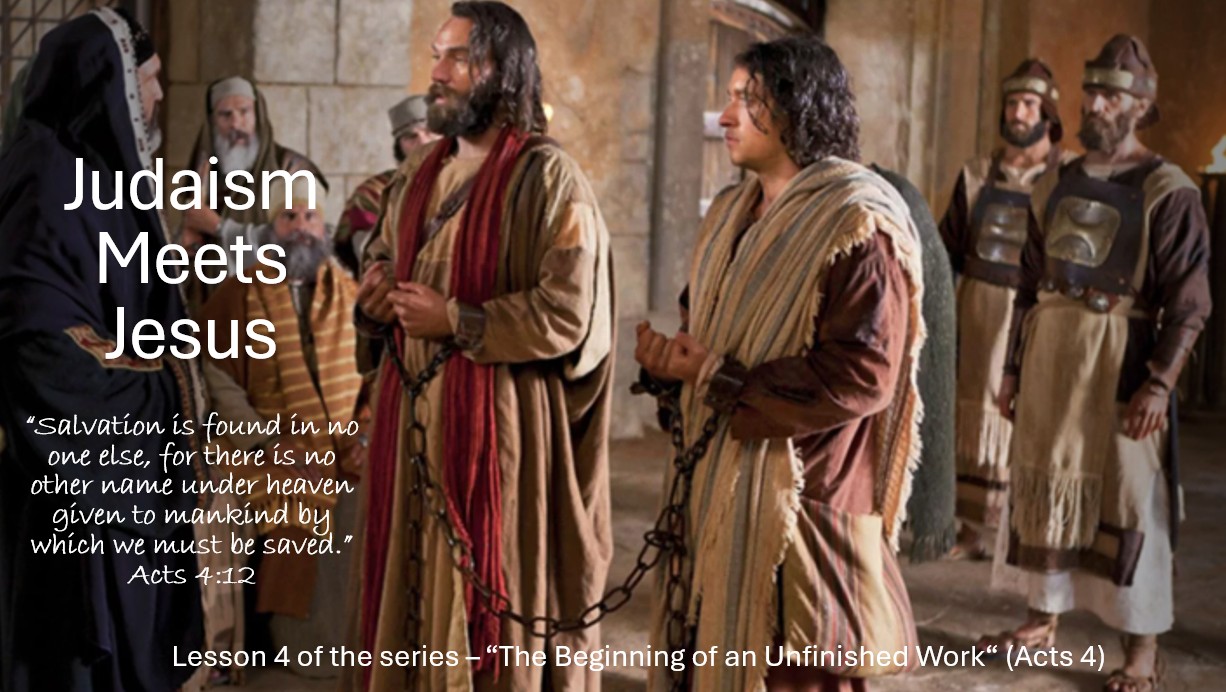
Judaism Meets Jesus – Acts 4
Part 4 in the Series – “The Beginning of an Unfinished Work”
With the birth and establishment of the Church (Acts 1-3) now on clear footing; the Jewish “religious leaders” begin to take notice. The Holy Spirit is working in the lives (through conviction) of both the religious leaders as well as the common person. Some will fully embrace Christ while others will continue to reject Him. Many of the religious leaders didn’t agree with the message that the Apostles were declaring but were paralyzed to do anything.
The cornerstone message that the apostles were teaching was the resurrection of Jesus from the dead. The apostles were witnesses to the resurrection of Jesus and for 40 days after that they listened to him teach about the kingdom, they ate with him and fellowshipped with him. They were compelled to proclaim the message that Jesus rose from the dead. This caused enough concern from the religious leaders that they decided to arrest Peter and John and convene a meeting of the Sanhedrin to determine if this healing of the crippled man (Acts 3) was valid and by what authority they could perform this miracle.
Peter set out to preach another sermon where he once again reminds the religious leaders that their authority to heal this man rested in the Name of Jesus Christ – the One they crucified! It was Jesus that granted them the authority and power to heal.
“Jesus called his twelve disciples to him and gave them authority to drive out impure spirits and to heal every disease and sickness. These are the names of the twelve apostles: first, Simon (who is called Peter) and his brother Andrew; James son of Zebedee, and his brother John; Philip and Bartholomew; Thomas and Matthew the tax collector; James son of Alphaeus, and Thaddaeus; Simon the Zealot and Judas Iscariot, who betrayed him. These twelve Jesus sent out with the following instructions: “Do not go among the Gentiles or enter any town of the Samaritans. Go rather to the lost sheep of Israel. As you go, proclaim this message: ‘The kingdom of heaven has come near.’ Heal the sick, raise the dead, cleanse those who have leprosy, drive out demons. Freely you have received; freely give.” (Matthew 10:1-8)
The beggar (who was crippled) now stands before them in good health and complete wholeness of which the religious leaders could not dispute. Peter declares to them that the only way to cure their problem was to repent and believe in Jesus Christ. The religious leaders lacked faith, and they had no response for the crippled man walking in their midst because they didn’t believe in Jesus. They couldn’t prove Peter or James had done anything wrong and thus were unable to punish them for anything. The best solution they could produce was they told them to stop teaching about Jesus.
“It is particularly striking that neither on this nor on any subsequent occasion (as far as our information goes) did the Sanhedrin take any serious action to disprove the apostle’s central affirmation – the resurrection of Jesus. Had it been possible to refute them on this point, how readily would the Sanhedrin have seized the opportunity! Had they succeeded, how quickly and completely the new movement would have collapsed! (F.F. Bruce – The Book of Acts [Grand Rapids; Eerdmans, 1971 page 102)
Peter and John are subsequently released and they return to their brethren and continue to preach and teach about Jesus. In addition, we are told they continue to perform more miracles and wonders. This results in the church expanding to well over 10,000 people. They are unified in their love for one another, and they care for each other’s needs. They will face more persecution but that won’t stop them from declaring the truth that Jesus is the only way to God!
“A new command I give you: Love one another. As I have loved you, you must love one another. By this everyone will know that you are my disciples, if you love one another.” (John 13:34-35)
“Jesus answered, “I am the way and the truth and the life. No one comes to the Father except through me.” (John 14:6)

