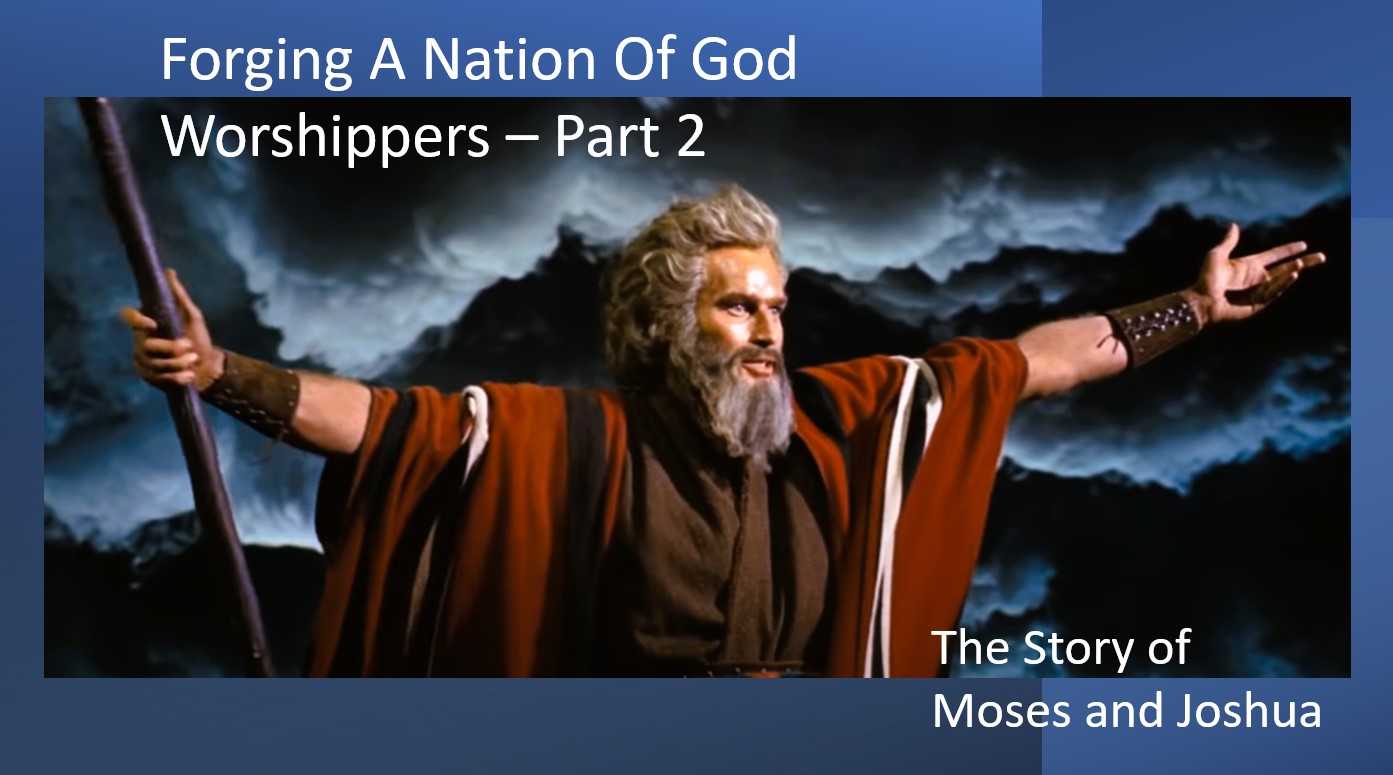
Forging a Nation of God Worshippers – The Story of Moses and Joshua – Part 2

We learned from last weeks lesson (Forging a Nation of God Worshippers Part 1) that the God of Abraham, Isaac, and Jacob would deliver the children of Israel from Egyptian bondage and lead them back to the land He promised Abraham. “Then the Lord said to him, “Know for certain that for four hundred years your descendants will be strangers in a country not their own and that they will be enslaved and mistreated there. But I will punish the nation they serve as slaves, and afterward they will come out with great possessions. You, however, will go to your ancestors in peace and be buried at a good old age. In the fourth generation your descendants will come back here, for the sin of the Amorites has not yet reached its full measure.” (Genesis 15:13-16).

This lesson begins with Moses leading the Israelites out of Egypt and immediately they face their first challenge. The Israelites found themselves stuck between the armies of Pharoah and the Red Sea. While the angel of God held back the armies of Pharoah, the Lord parted the Red Sea allowing the Israelites to cross on dry land. Once the Israelites were safely across, the armies of Pharoah continued their pursuit and found themselves under the judgement of God for their actions against His people. The lesson concludes with Joshua leading the Israelites into the Land of Promise.

The conclusion of our 2-part series will show how God fulfills His promises and displays His power as written in the Books of Exodus, Leviticus, Numbers and Deuteronomy:

God Protects – He parts the Red Sea and saves them from the Egyptians

God Provides – He supplies them with nourishment (manna and water)

God Commands – He gives them specific Laws to obey

God Guides – He leads them to the Land of Promise

God Abides – He dwells among them and defines how to properly worship their Creator

God Instructs – He teaches them how to “be right” with God and man

God Chooses – He honors those who honor and obey Him

God Affirms – He blesses and honors Joshua with the task of leading the Israelites to the Land of Promise and Joshua does just as he was instructed.

God’s promise to Joshua: “This Book of the Law shall not depart out of your mouth, but you shall meditate in it day and night, that you may observe to do according to all that is written in it. For then you will make your way prosperous, and then you will have good success. Have I not commanded you? Be strong and of good courage; do not be afraid, nor be dismayed, for the Lord God is with you wherever you go.” (Joshua 1:8-9)

Forging a Nation of God Worshippers – The Story of Moses and Joshua – Part 1

Forging a Nation of God Worshippers

The Story of Moses and Joshua – Part 1

This lesson picks up the story found at the end of the Book of Genesis where Joseph (son of Jacob, now called Israel), found himself in Egypt (through the providence of God) and created a path for the Israelites to survive a famine and grow from a family tribe of approximately 70 people to a nation of over 1 million souls by the time of their Exodus from Egypt.

Initially the Israelites were favorably disposed and, in many cases, held in high esteem while they resided in Egypt. However, things changed, and a new Pharoah came to power and the Israelites were enslaved and forced to build buildings and other infrastructural components in Egypt all the while being severely mistreated. The Lord told Abraham many years prior that this would happen; “Then the Lord said to him, “Know for certain that for four hundred years your descendants will be strangers in a country not their own and that they will be enslaved and mistreated there. But I will punish the nation they serve as slaves, and afterward they will come out with great possessions. You, however, will go to your ancestors in peace and be buried at a good old age. In the fourth generation your descendants will come back here, for the sin of the Amorites has not yet reached its full measure.” (Genesis 15:13-16)

During the Israelite’s bondage in Egypt, they cried out to be delivered from this oppression and God heard their cries and answered their prayers. God had plans to deliver His chosen people and the man who would lead them out from Egypt was Moses. This is the story of not just their exodus form Egypt but a formation of a people who would learn to worship their God, the only True God, and witness His mighty power, the likes of which no one has ever seen before.

There will be highs and lows, hills and valleys, victories and defeats, joy and sorrow, rebellion and obedience, blessings, and curses, but in the end, God will deliver them as He said He would. Our primary focus for this lesson is the events leading up to the Exodus from Egypt, and how God delivers the Israelites from Egyptian bondage. It’s a true story and one worth taking the time to seriously contemplate as no other nation, culture or people group has been blessed, protected, or cared for as God has done for the Israelites. He is a Promise Keeping God!

For Such A Time As This – The Story of Esther and Mordecai, Part V

For Such A Time As This – The Story of Esther & Mordecai

Part V – A Tale of Two Edicts

As we wrap up our study of the Book of Esther – let’s review what we have learned so far:

  1. Esther and Mordecai lived somewhere in the heart of the Persian Empire – in close proximity to Shushan (Susa) which was the winter palace of King Xerxes.
  2. Esther and Mordecai’s grandparents were part of the Jewish nobility that were originally taken into captivity by Nebuchadnezzar, King of Babylon.
  3. Once the Babylonian captivity ended (70 years) the Jews had been instructed (by Jeremiah the prophet – see Jeremiah 25 & 29) to return to Jerusalem. Many of them did when Cyrus the Great issued the decree for the Jews to return to Jerusalem to re-build their Temple. (Ezra 1:1-4)
  4. The families of Esther and Mordecai chose not to return to Jerusalem as instructed and found themselves in a foreign land outside of the blessings God had planned for them in Jerusalem. (Jeremiah 29:10-14)
  5. Through a series of events (Esther 1-2), Esther will find herself in the position of the Queen of Persia. Mordecai, initially having access to the Kings court because of Esther will overhear an assassination plot to kill King Xerxes. Although this helps the King and spares his life, Mordecai “initially” receives no credit for helping the King.
  6. At some point during the reign of Xerxes, a person by the name of Haman will rise to a significant rank within the Persian Empire and become an advisor to the King – much like a Prime Minister.
  7. Haman (because of his position) will require submission by all within the Empire but Mordecai refuses to bow down to him. Haman will discover that Mordecai is a Jew and as a result, Haman will hatch a diabolical plan to kill not just Mordecai, but all Jews within the Persian Empire.
  8. Mordecai will appeal to Esther to use her influence with the King to put a stop to this evil plan and will instruct her that she may well have been placed in the position of Queen “for such a time as this”!
  9. Esther will prepare a banquet and invites Haman and the King where she intends to let the King know she would be included in this destruction of her people as she too was a Jew.
  10. The King will have a restless night and the Lord will stir his heart to remember the assassination attempt on his life which took place some five years earlier. This will cause the King to recognize Mordecai for what he did and honor him with high honors and asks Haman to bestow those honors on Mordecai.
  11. While that is all going on, Esther will reveal to the King that Haman’s plan to kill the Jews also involved her as they were her people given, she was also a Jew.
  12. This infuriates the King and results in the King declaring Haman an “enemy of the Jews”. Haman will subsequently be impaled on the very gallows (pole) that he intended to place Mordecai on. This will result in Mordecai receiving special honor and an opportunity to save the Jews from annihilation and our final lesson explains how that takes place.

The King was bound by the original edict (Esther 3:13) to destroy, kill, and annihilate all Jews in the Persian Empire even though his Queen and New Prime Minister were Jews. That original law/edict could not be altered or revoked (because of Medo-Persian Law) or the King risked possible removal or even death.

The King will instead empower Mordecai and Esther to draft their own law and put it on the books. No doubt this was all a part of God’s plan to save the Jews from extinction. The plan that Mordecai and Esther drew up was a just law and much different from the murderous plan that Haman had put together. The new law will allow the Jews to formally defend themselves on the day that was originally planned to have all the Jews in the Empire killed. This will turn tragedy into triumph for the Jews and allow them to continue as God had planned for he was not finished with them yet.

At the conclusion of the Book of Esther we are introduced to a new feast that the Jews were to celebrate, and the name given was the Feast of Purim. Although it is not one of the required feasts of the Mosaic Law, it remains a celebrated feast within the Jewish culture even to this very day. This feast (a two-day celebration) serves as a reminder to the Jews that they were saved from annihilation (though not directly mentioned in the Book of Esther) because God protected them. This book is not just about the Lord’s protection for His people (The Jews), but it also makes it possible for the Lord to provide full redemption through the promised Messiah, Jesus a descendant of King David. “But when the fullness of time came, God sent forth His Son, born of a woman, born under the Law so that He might redeem those who are under the Law, that we might receive the adoption as sons” (Galatians 4:4-5)

For Such A Time As This – The Story of Esther and Mordecai, Part IV

For Such A Time As This – The Story of Esther & Mordecai

Part IV – A Tale of Two Choices

Everything we read about Haman reveals a wicked and diabolical man who has taken the path of evil which (as we will see) will further result in a life of pride and arrogance leading to his eventual demise. This is precisely what taking the path of evil looks like and pride is what led to the downfall of Satan and the very path (“the wide road that leads to destruction” – Matthew 7:13-14) he is attempting to cause the whole of mankind to also follow.

Mordecai and Esther have taken the path of good which (as we will see) will further result in a life of humility which will lead to their success in saving their people from extinction. Despite the evil intentions of Haman, Esther will take a bold step (being led by God) by reaching out to the King which will create an opportunity for her to plead to the king for not just her life but the lives of her people the Jews. God will use the good intentions of Esther to successfully circumvent the evil intentions of Haman.

Before this meeting with the King takes place, Haman’s pride gets the best of him, and he will have the gallows built intending to use them to put Mordecai (in full display) to death. Hatred and bitterness (a product of pride) seemed to control Haman so much that it worked against him and the gallows that he built to have Mordecai killed would be used on himself.

C.S. Lewis wrote, “The essential vice, the utmost evil, is Pride. Unchastely anger, greed, drunkenness and all that, are mere fleabites in comparison; it was through pride that the devil became the devil; Pride leads to every other vice; it is the complete anti-God state of mind…..as long as you are proud you cannot know God at all. A proud man is always looking down on things and people: and of course, as long as you are looking down, you cannot see something that is above you.”

It is only by the grace of God and his providential leading that King Xerxes has a restless night and will be stirred to examine the Persian records regarding the incident in which Mordecai previously uncovered a plot to have the King assassinated. It was Mordecai’s humility that allowed him to forgo any previous recognition but will now change not just his circumstances but also that of Haman’s. This, along with some additional findings by the King will bring judgment on Haman and blessings on Mordecai and Esther. They (Mordecai, Esther and all Jews in the Persian Kingdom) still have to face the previous edict/law requiring they be put to death – but that outcome will be found in our final lesson for next week.

For Such A Time As This – The Story of Esther and Mordecai, Part III

For Such A Time As This – The Story of Esther & Mordecai

Part III – A Tale of Two Paths

We pick up our story with Esther now serving as the Queen of the Persian Empire! We learned from last weeks lesson that this was no accident, but it was the providential hand of the Lord God. This was no mere set of coincidental circumstances that a young Jewish woman would now serve in the roll of the Queen of the mighty Persian Empire but that will show itself in the chapters that follow in the Book of Esther.

Now that Esther is Queen, her status will allow Mordecai (her cousin who probably adopted her and raised her as his own daughter) to have a watchful eye over her. This  position will allow Mordecai to overhear a plot to kill/assassinate King Xerxes and he will report that to Queen Esther who then reports that to King Xerxes and those conspirators are put to death. Unfortunately, Mordecai doesn’t receive immediate credit (he will later but that is for another lesson) and another up and comer by the name of Haman will rise to power as a key leader in the Persian government and he will have the ear of King Xerxes.

Haman (as we will discover) is an evil man and through a set of events will develop a hatred for Mordecai because he refuses to bow down to him. Haman will also find out that Mordecai is a Jew and will hatch an evil plan to kill Mordecai and all Jews throughout the empire. The Jewish heritage of Esther is yet to be revealed but in due time she will reveal her heritage to the King and both her will and her faith will be tested once the evil plot of Haman to kill and annihilate all Jews in the Persian Empire is put into place.

This lesson, titled A Tale of Two Paths, is about good and evil. Haman represents evil and all that goes along with the choice of that path. Mordecai and Esther represent good and all that goes along with choosing that path. It’s much like the lesson that Jesus taught his disciples when he said, “Enter through the narrow gate. For wide is the gate and broad is the road that leads to destruction, and many enter through it. But small is the gate and narrow the road that leads to life, and only few find it.”

Haman will choose the path of evil and will suffer the results of that decision while Esther and Mordecai will choose the path of good resulting in life for both them and their people. The lessons learned here is this study is that good will always triumph over evil and God’s providence will always prevail!

For Such A Time As This – The Story of Esther and Mordecai, Part II

For Such A Time As This – The Story of Esther & Mordecai

Part II – A Tale of Two Queens

In this lesson we find the King of the Persian Empire who is called by Ahasuerus (a transliteration of his Persian name Khshayarsha) or by his Greek name Xerxes and he is reigning over the 127 provinces of Persia which includes the land of Judah/Palestine. Xerxes was a very powerful King and the empire that he ruled over was equally powerful, so much so, it rivalled that of the Greek Empire of his time.

The first chapter of the Book of Esther introduces us to a lavish party that Xerxes put together for his military leaders and nobility to celebrate their accomplishments as an empire. The timing of this party fits into the historical record in which Xerxes was “poking the bear” and preparing to take on the Greek Empire in battle. It was common for Kings to throw lavish parties both to celebrate past victories and to prepare the military leaders for upcoming battles. Although we are not specifically told this was the purpose of the party mentioned in Esther 1 – it is certainly a strong possibility.

At this banquet we are introduced to Queen Vashti who was the reigning Queen over the Persian Empire along with Xerxes. Unfortunately for her she refuses to comply with the Kings request, and this results in her being deposed/removed as queen. This creates an interesting opportunity for the other women of the Persian Empire and as the chapter unfolds, we will see this opens the door for Esther (a young Jewish woman) to become Queen and thus replaces Vashti.

 This was no coincidence and clearly is the providential hand of The Lord God who places Esther in the right place at the right time or better defined as “Such a Time as This”. Esther will win the favor of King Xerxes and her beauty (both inside and outside) captivated Xerxes so much she was given “most favored status” even though she was a Jew. Esther’s heritage will play a roll in the events that unfold through the Book of Esther but for this moment she was the talk of the town.

In each of these opportunities we can see the providence of God at work. The way in which He orchestrates His will to be accomplished despite what may seem (to some) as unimportant at the time or a mere coincidence but, is divine intervention for His purposes and our good. The Apostle Paul writes it this way; “And we know that in all things God works for the good of those who love him, who have been called according to his purpose” (Romans 8:28)

For Such A Time As This – The Story of Esther and Mordecai, Part I

For Such A Time As This – The Story of Esther & Mordecai

Part I – Introduction/Overview

By way of introduction, there are a few interesting items to consider about the Old Testament Book of Esther. First and foremost, the book appears in the Old Testament as the 17th book of the Bible, but the historic/chronological context would place the events of Esther as one of the last 4 Books of the Old Testament.

The events of the Book of Esther take place over a period of 10 years (483 – 473 BC) during the reign of the Persian King Ahasuerus (aka Xerxes) who ruled over the 127 provinces of the Persian Empire from 485-465 BC. Prior to this time, the Jews (of the Southern Kingdom of Judah) were taken from their lands of Judah and relocated to the land of Babylon. This was known as the “Exile” and something that was prophesied to happen by Jeremiah the prophet. Eventually the Babylonian Empire was conquered by the Persians in 539 BC, and they ruled over the people of Judah until a later date when the Greeks conquer the Persian Empire.  It was Cyrus the Great (great grandfather to King Ahasuerus) who will decree that the Jews would be permitted to return to their homeland and rebuild their temple. Many Jews will return to Jerusalem as they were instructed to do, and you can read about that in the books of Ezra, Haggai, and Zechariah.

The story of Esther is about those Jews who remained behind in Persia and did not return to Jerusalem as thy were commanded to do. Esther and Mordecai’s grandparents were part of the group that remained behind in Persia and set the stage for the events recorded in the book of Esther. The story that unfolds in the Book of Esther is a powerful testimony to the sovereign protection of God as He purposes to fulfill the promises made to Abraham and his descendants. We will be introduced to two wonderful people, Esther, and Mordecai, who God will use to spare the people of promise (the Jews) from complete annihilation by an evil man named Haman. It will be Esther and Mordecai, who stand in the gap and assists their people in protecting themselves and ultimately securing the lineage of King David that would one day bring about the Messiah, Jesus Christ.

The First Family of Faith – The Story of Abraham and Sarah Part 2

Our story picks up with Abraham, Sarah and Lot facing some growing pains. Both Lot and Abrahams herds have grown and so had their possessions which created a need for them to go their separate ways. Lot had a passion toward wickedness which was evident by his choice to go in the direction of Sodom. Abraham and Sarah’s passion was to worship God and follow Him which was evident in the choices they made.

This decision by Abraham and Sarah will bring about a covenant (a promise) that God makes with Abraham in which he not only promises him a male heir who will receive the same covenant promise that God makes to Abraham but also future offspring too numerous to count. In addition, he would be blessed with a land that was so vast and large it too could not be fully grasped as to its size.

There will be a several important developments involving Lot, Abraham, and Sarah along with the consequences of a bad decision. In the end God’s promise of a son that would be the offspring of Abraham and Sarah will come true. From that child (Isaac) will come future generations of descendants (too numerous to count) that will call out to God and worship Him. Abraham and Sarah’s faith will be tested, and God will honor their faith with a legacy that spans the entire Bible and continues even to our modern day. “Consider Abraham: He believed God, and it was credited to him as righteousness. Understand then, that those who believe are children of Abraham. The scripture foresaw that God would justify the Gentiles by faith and announce the gospel in advance to Abraham: All nations will be blessed through you. So those who have faith are blessed along with Abraham, the man of faith” (Galatians 3:6-9)