Part 2 – Why The Resurrection

When Jesus was betrayed by Judas Iscariot and subsequently arrested by representatives of the chief priests and elders, He voluntarily submitted to be taken to trial before the Sanhedrin (The governing body of Jewish Temple). Jesus did this as it was a fulfillment of what the Old Testament prophets spoke of (read – Isaiah 53). This was all a part of God’s plan. The initial accusations and charges didn’t rise to the level of requiring death, but when the high priest asked Jesus; “are you the Messiah, the Son of God? It was His response that provides the answer to Why the Resurrection? “You have said so, Jesus replied. But I say to all of you: From now on you will see the Son of Man sitting at the right hand of the Mighty One and coming on the clouds of heaven” (Matthew 26:64). To the Jewish leaders who heard this response by Jesus considered it blasphemy, for to them Jesus was declaring himself to be equal with God. However, their method of punishment for such a claim was to be stoned to death. This was not the plan of God but instead Jesus would be presented before a Roman governor named Pontius Pilate who ultimately would pronounce judgement to crucify Him. As such, hundreds, if not thousands would witness the horrendous punishment inflicted by the Roman soldiers upon Jesus (a fulfillment of what the prophets foretold) and ultimately nailed Him to the cross because God willed it so. At any point, Jesus could have called the entire host of angels to stop such a cruel punishment, but He voluntarily submitted Himself to die for the sins of the world. Jesus was nailed to the cross and there were sufficient witnesses to that fact – four gospel accounts, 26 New Testament books, hundreds and probably thousands who witnessed the crucifixion and death.

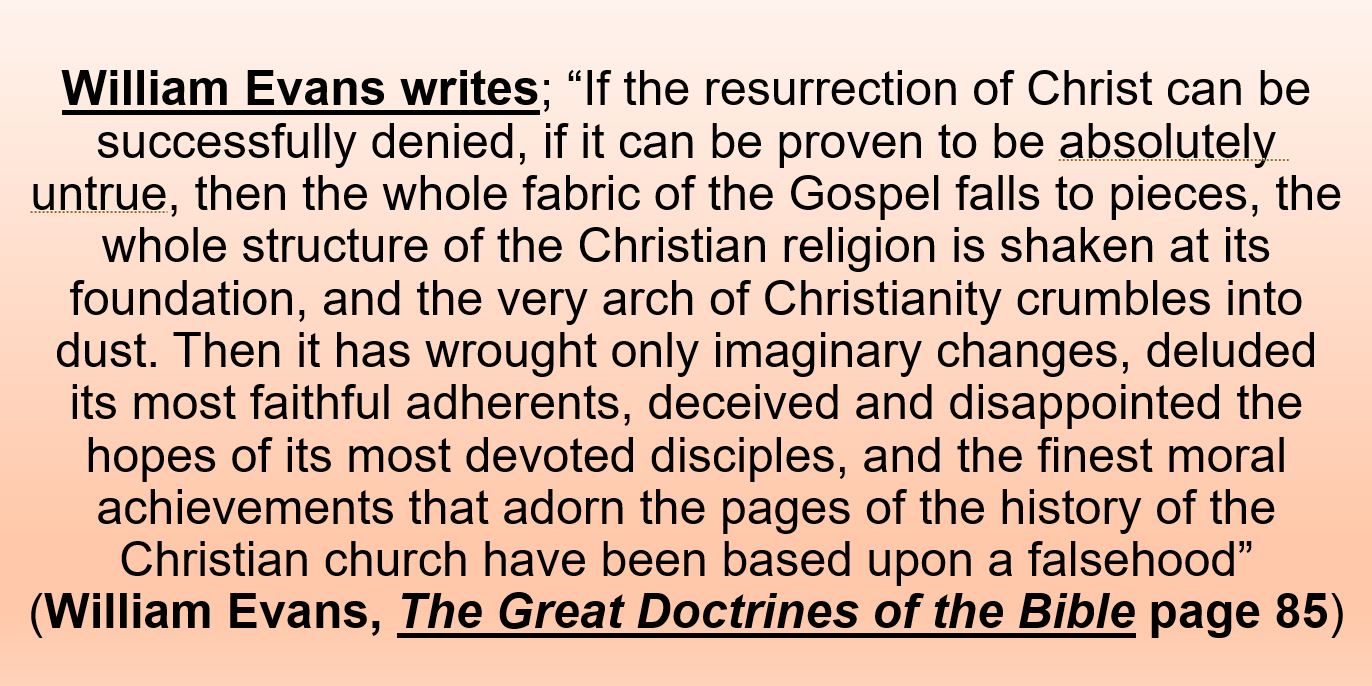
After His death, Jesus was placed in a tomb. The religious leaders went to great extremes to ensure His body stayed there and even had a stone rolled in front of the opening of the tomb to ensure his body could not be stolen. Well, 3 days later Jesus rose from the dead, because He is God and to fulfill what He told His disciples He would do. Now, there have been plenty of doubters and skeptics from then until now who claim it didn’t happen. To deny the resurrection doesn’t mean it didn’t happen but the evidence that it did happen is overwhelming! You will have to read the attached lesson to see for yourself and if I didn’t cover it thorough enough – read the Bible for yourself and draw your own conclusions. Consider this:

Why the Resurrection? Because that was always God’s plan to redeem fallen man and ransom us from eternal separation from the One who created us. All He asks is that we trust and believe Him. (John 3:16-18, Romans 10:9-10)

Part 1 – Why The Cross

Simply put – because of sin (defined as complete rebellion against a perfect, righteous and holy God) our relationship with God was broken and in need of redemption. Because sin separated us from God, the only way we could be reconciled to Him was through the atoning death on the cross by the perfect sacrifice which was Jesus Christ (John 1:1-18). Jesus Christ’s death on the cross was our atonement (making us “at one” with God) and something only Jesus could do given He was God in human flesh. He was not made God – He is God.

There is great disagreement, even among the other 2 monotheistic (One God) religions (Islam and Judaism) that exist in our world as to how we are reconciled to God. Like Islam and Judaism, many other “religions” fall short on answering the question of how our sins are atoned for and in some “humanistic” religions they just ignore than sin even exists. I call these religions or belief systems:

Christianity is based on faith and belief in Jesus Christ. It was His death on the cross that paid our “ransom” and delivered us from death and eternal separation from God. This is accomplished not by something we do but something that was done. “For God so loved the world that He gave His only begotten Son, that whoever believes in Him should not perish but have everlasting life. For God did not send His Son into the world to condemn the world, but that the world through Him might be saved. He who believes in Him is not condemned, but he who does not believe is condemned already, because he has not believed in the name of the only begotten Son of God” John 3:16-18. Christianity differs from all other religions and belief systems because:

Rise and Fall of Israel’s Monarchs – Kings of Judah Part II

Cover Page

This week’s study on the Rise and Fall of Israel’s Monarch’s is the final lesson of this series and continues with a look at the final 10 Kings of the Southern Kingdom of Judah. Unlike the Northern Kingdom of Israel which had 9 dynasties, the Southern Kingdom of Judah had but just one, as all the Kings of Judah were direct descendants of David. There are only 3 kings (Jotham, Hezekiah and Josiah) out of the final 10 Kings of the Southern Kingdom of Judah that are considered good. It will be during the reign of Ahaz and his son Hezekiah in which the Northern Kingdom of Israel will be completely destroyed by the Assyrians. The two most notable kings of the Southern Kingdom of Judah during the remaining 160 +/- years of that kingdom were Hezekiah and Josiah. Each of these two kings were noted as doing right in the sight of the Lord and each made significant reforms to draw the people’s hearts back to the Lord. Of all the kings who ruled the Southern Kingdom of Judah there was only king who had no record of doing anything that brought shame to himself or his Lord and that was Josiah. Josiah neither worshipped false gods, nor did he make any alliances with those who were enemies of the Lord, and he is noted for significant reforms that helped provide a strong foundation for future leaders (i.e. Ezra, Zerubbabel, and Nehemiah) who would help lead the people of God back to Jerusalem after they are conquered by the Babylonians and removed from their lands. The story of the people of God (The Israelites or Jews) doesn’t end with the removal of the last king of Judah (Zedekiah), even though there was no king who would reign on the throne of Israel or Judah throughout the days of Babylonian captivity. There wasn’t even a legitimate king (a descendant of David) who ruled during the days when the people of God are permitted (by Cyrus of Persia) to return to their land and rebuilt their temple and their city. Even during the days of Greek and Roman occupation no legitimate king (a descendant of David) ever ruled over the people of God until the birth of the Messiah Jesus Christ who is the King of Kings and the One whom Daniel the prophet writes about in Daniel 7:11-14 whose rule and reign will be everlasting and whose kingdom will have no end.

Lesson 7 – The Kings of Judah (Student Copy)

Lesson 7 – The Kings of Judah (Teacher Copy)

Lesson 7 – The Kings of Judah Part II – PPT

Rise and Fall of Israel’s Monarchs – Kings of Judah Part I

Cover Page

This week’s study on the Rise and Fall of Israel’s Monarch’s continues with a look at the Kings of the Southern Kingdom of Judah. Unlike the Northern Kingdom of Israel which had 9 dynasties, the Southern Kingdom of Judah had but just one, as all the Kings of Judah were direct descendants of David. Of all of the 19 kings of the Southern Kingdom of Judah, there were just 8 of them who were noted as good kings. The rest of the 11 kings were wicked and some more so than others. There are a few twists and turns due to some unique familial ties to King Ahab of the Northern Kingdom of Israel which bring about the only reigning queen of the Southern Kingdom of Judah. There was also continual warfare between both the Northern Kingdom of Israel and the Southern Kingdom of Judah. In addition to that the neighboring countries and empires that once paid homage and tribute to King David and Solomon would once again become their enemies and eventually the Southern Kingdom of Judah will be completely defeated by the Babylonians in 586 B.C. and they will be taken into captivity. This final portion of the study is divided into two parts due to the need to explore several of the good kings who diligently seek the Lord with their whole heart and establish well needed reforms to guide the people back toward the Lord. This week’s study will begin with King Abijah (King Rehoboam’s son) and conclude with King Uzziah (Azariah) covering the years 913-739 B.C. and our last and final study will cover the remaining kings of Judah.

Lesson 7 – The Kings of Judah (Student Copy)

Lesson 7 – The Kings of Judah (Teacher Copy)

Lesson 7 The Kings of Judah Part I – PPT

Rise and Fall of Israel’s Monarchs – The Kings of Israel

Cover Page

This week’s study on the Rise and Fall of Israel’s Monarch’s continues with a look at the Kings of the Northern Kingdom of Israel. After Jeroboam’s 22 year reign as the Northern Kingdom’s first king his son Nadab will succeed him to the throne and continue the wicked and evil practices of his father. This cycle of wickedness (most often marked by idol worship, perversion and complete disregard for Mosaic Law) continued for 188 years (931-722 B.C.) and all 19 kings of the Northern Kingdom of Israel are noted for doing evil in the sight of the Lord. The Northern Kingdom of Israel will have a total of 9 dynasties unlike the Southern Kingdom of Judah which has only one. The most prominent king of Israel is Ahab who was the Al Capone of his time and probably the most ruthless and vile leader to ever rule over either kingdom. King Ahab and his wife Jezebel were personally responsible for hunting down and killing the prophets of the Lord as well as promoting idol worship throughout the Land of Israel. Other prominent kings of Israel (all wicked) were Omri, Jehu and Jeroboam II to mention just a few. Their accomplishments were primarily political but neither accomplished anything of spiritual value. In the end the people of the Northern Kingdom of Israel and their capital of Samaria fell to the Assyrian Empire in 722 B.C. As such, the promises of the Lord to the people of the covenant (the descendants of Abraham, Isaac, and Jacob) would be fulfilled through the Southern Kingdom of Judah. That lesson is for next week….stay tuned.

Lesson 6 – The Kings of Israel (Student Copy)

Lesson 6 – The Kings of Israel (Teacher Copy)

Lesson 6 – The Kings of Israel – PPT

Rise and Fall of Israel’s Monarchs – A Divided Kingdom

Cover Page

This week’s study on the Rise and Fall of Israel’s Monarch’s continues with a look at the Kingdom of Israel in trouble. Upon the death of Solomon, the United Kingdom of Israel will divide along similar lines that existed prior to the reign of King David. Much of this was due to the failures during the portion of Solomon’s reign in which he worshipped and pursued false gods which was forbidden by the Lord. The allowance of idol worship in the kingdom became a continual problem during the reign of all the kings of Israel and Judah. The failure of the kings to pursue the Lord wholeheartedly is at the root of the division between the Northern Kingdom of Israel and the Southern Kingdom of Judah. The division begins after Solomon dies in which the 10 northern tribes of Israel will follow Jeroboam (one of Solomon’s servants) and the other 2 tribes of Judah and Benjamin will follow Rehoboam (Solomon’s son). This civil war will continue for hundreds of years and the two kingdoms will never formally unite again. Each kingdom will have its own king. Those of the Northern Kingdom will establish their own set of kings (all wicked and evil), their own temple and their own form of worship which will primarily be a worship of false pagan gods. Those of the Southern Kingdom of Judah will fare a little better and their kings (all descendants of David) will be a mixture of good and bad kings, yet in spite of themselves and their often falling away from true worship of the Lord, they will at times repent and restore themselves to the Lord. This transition from a United Kingdom to a divided one is a bid of a sad story but all is not lost, and the Lord’s plan to restore His people to Himself is ultimately found in the Messiah – Jesus Christ.

Lesson 5 – A Divided Kingdom (Student Copy)

Lesson 5 – A Divided Kingdom (Teacher Copy)

Lesson 5 – A Divided Kingdom – PPT

Rise and Fall of Israel’s Monarch’s – King Solomon Part II

Cover Page

This week’s study on the Rise and Fall of Israel’s Monarch’s continues with a look into the life of King Solomon – David’s son. Solomon will reign as King of Israel for a total of 40 years and he will expand the borders of the kingdom to their largest ever for any King who ruled over Israel. During Solomon’s reign he will build the Temple and will live at peace with his neighbors unlike his father David. Solomon will be blessed by the Lord with wisdom, wealth, honor, and a long life. Solomon will speak or write over 3000 proverbs (several hundred of which are preserved in the Books of Proverbs and Ecclesiastes), he also wrote 1005 songs (one of which was recorded as The Song of Songs) and he was an expert in botany and zoology. Solomon was considered to be one of the wisest men to ever walk this planet and yet in spite of that wisdom, he failed to guard himself against complacency and the temptations of evil. As we will see in this portion of our study, Solomon makes a number of bad choices during the middle portion of his reign which leads to a pattern of sin that brings severe judgment upon him. In addition, his pursuit of worshipping false gods really becomes his undoing and will bring about the division of the Kingdom of Israel. It is a bit of a sad turn of events for a man who was given so much wisdom and wealth but Solomon will admit in other writings what happens when we get our focus off of the Lord and turn that focus on earthly things. Solomon will eventually write the Book of Ecclesiastes which will serve as an acknowledgement of his failures, an admittance of his errors and an assent toward repentance as he openly declares that the whole duty of man is to fear God and keep His commandments. Sadly this change of heart is too little too late and the damage is done as the United Kingdom of Israel will fracture in two. Stay tuned – more to come.

Lesson 4 – King Solomon (Student Copy)

Lesson 4 – King Solomon (Teacher)

Lesson 4 – King Solomon Part II – PPT

Rise and Fall of Israel’s Monarchs – King Solomon Part I

Cover Page

Of all of David’s sons, his choice to reign alongside of him during the final years of his life was Solomon. David made preparations for the construction of the temple and it would become Solomon’s task to complete. Solomon was the Lord’s choice to reign after David and Solomon was also embraced by the people of Israel to be their king. Solomon will reign as King of Israel for a total of 40 years and he will expand the borders of the kingdom to their largest ever for any King who ruled over Israel. During Solomon’s reign he will build the Temple and will live at peace with his neighbors unlike his father David. Solomon will be blessed by the Lord with wisdom, wealth, honor, and a long life. Solomon will speak or write over 3000 proverbs (several hundred of which are preserved in the Books of Proverbs and Ecclesiastes), he also wrote 1005 songs (one of which was recorded as The Song of Songs) and he was an expert in botany and zoology. Solomon was considered to be one of the wisest men to ever walk this planet and yet in spite of that wisdom, he failed to guard himself against complacency and the temptations of evil. In this portion of our study we will see Solomon at his best and in our next lesson we will see him at his worst, but the Lord will direct him toward repentance. Solomon will eventually write the Book of Ecclesiastes which will serve as an acknowledgement of his failures, an admittance of his errors and an assent toward repentance as he openly declares that the whole duty of man is to fear God and keep His commandments.

Lesson 4 – King Solomon (Student Copy)

Lesson 4 – King Solomon (Teacher)

Lesson 4 – King Solomon Part I – PPT

Rise and Fall of Israel’s Monarchs – King David Part III

Cover Page

This is the fifth installment in the series I am teaching this fall on the “Rise and Fall of Israel’s Monarchs”, which is a study on the Kings of Israel and Judah. During David’s first 20 years as king he continued to fight many battles and was away from home often. This resulted in all sorts of domestic failures at home, both for the nation, as well as in his personal family. This neglect of things at home, along with not completely following the teachings of scripture (Deut. 17:14-17), are what drove David into a cycle of sin that he struggled to break free from. David’s decisions to be unaccountable made him vulnerable to the very thing that made him such a notable person. His pursuit of righteousness (a man after God’s own heart), and integrity was blindsided by pride and arrogance because he didn’t allow himself to keep it in check! The days following David’s adultery with Bathsheba were some of his most challenging as he faced a number of family issues; the greatest of them was a rebellious son (Absalom) who sought to steal the kingdom away from him. David grieves over the bad decisions that he made and does show signs of a repentant heart but his actions (like ours) still have consequences. Over time the kingdom is restored to David but at a very heavy cost (the death of his son Absalom). Toward the end of his reign, David restores his relationship to the Lord, makes repairs to the fragile kingdom, and prepares to deliver a United Kingdom over to his son Solomon before he dies.

Lesson 3 – King David (Student Copy)

Lesson 3 – King David (Teacher Copy)

Lesson 3 – King David Part III – PPT

Rise and Fall of Israel’s Monarchs – King David Part II

Cover Page

This is the fourth installment in the series I am teaching this fall on the “Rise and Fall of Israel’s Monarchs”, which is a study on the Kings of Israel and Judah. In this portion of our study we will cover the portion of David’s life when he takes over as the King of Israel and Judah. After the death of Saul a civil war breaks out between the house of Saul (led by his son whose name was Ish-bosheth) and the house of David. The tribes of Israel will follow Ish-bosheth and the tribes of Benjamin and Judah will follow David. Eventually David’s following will grow strong and he will become the sole ruler of a United Kingdom of Israel at the age of 30. David will eventually move the capital to Jerusalem and will rule from there for about 33 years. During these years David’s family will grow and the kingdom will expand. David will be responsible for the implementation of the priesthood and re-focus attention on obedience to the Law and the elimination of idol worship within the kingdom. The Lord will make a covenant with David in which the Lord tells David that He will make his name great and that David’s throne would be established forever. David has a desire to build a house (Temple) for the Lord but that job is reserved for his son Solomon. David will be quite successful in defeating the neighboring countries causing them to fear the Lord and make peace with the people of Israel. This was probably the best years of David’s 40 year reign as king before things begin to unravel a bit.

Lesson 3 – King David (Student Copy)

Lesson 3 – King David (Teacher Copy)

Lesson 3 – King David Part II – PPT