From Chief Persecutor of the Church – To Its Most Humble Servant (Acts 9)
Part 8 in the Series – “The Beginning of an Unfinished Work”
The events recorded here by Luke in Acts 9 are directly linked to what transpired in Acts 6-8. Although Luke is not an eyewitness to this conversion account of Saul, he (at a later date) will become a travelling companion with Paul (formerly called Saul) and records Paul’s testimony of what occurred.
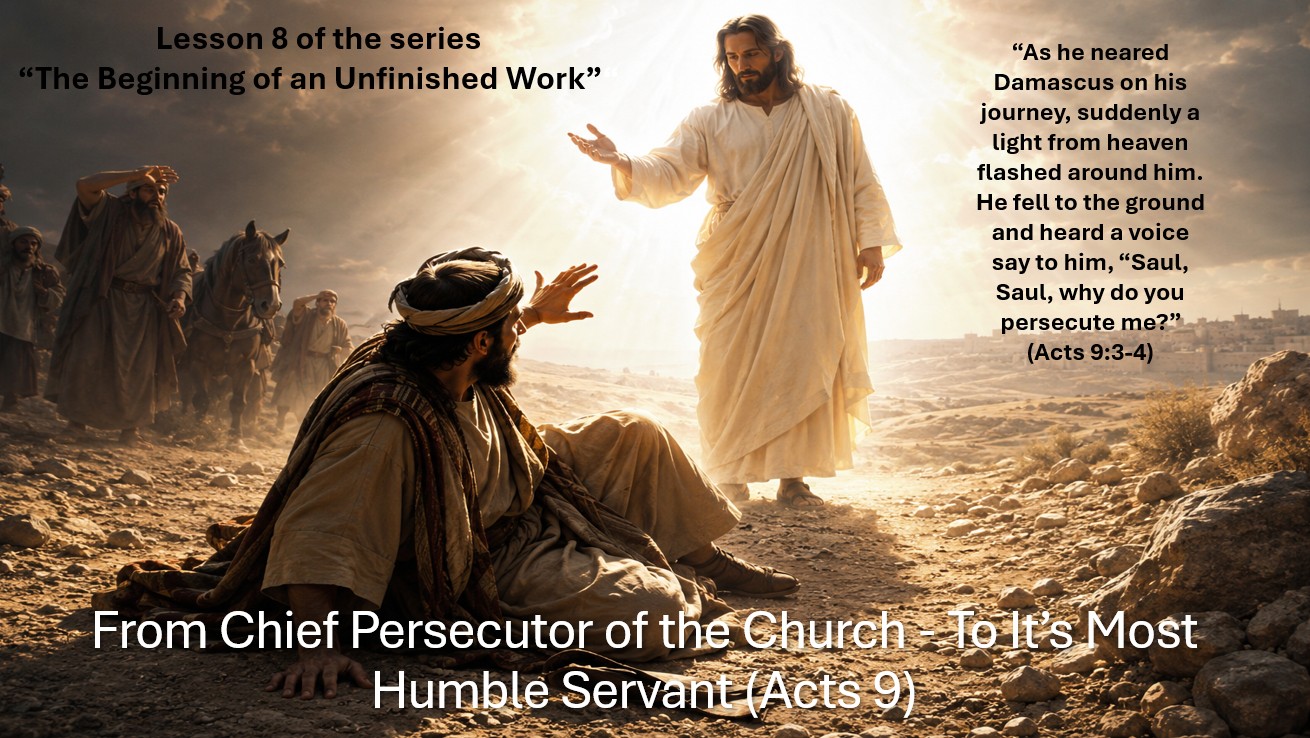
The apparent plan of the religious leaders (during this time) was to crush this movement of these “followers of the Way” by intimidating, persecuting and even killing those who spoke out against their “Jewish Laws”. We are told that Saul sought letters from the high priest who would authorize him to identify any followers of the “Way” (Jesus), arrest them, put them in chains, and bring them from Damascus back to Jerusalem for trial. While on his way to bring these Christ followers back to Jerusalem to be tried, he will travel toward Damascus believing there was a group of believers there. On his way to Damascus; he will meet Jesus and his life will forever be changed.
This was a turning point for Saul, marking the start of his conversion from being the chief persecutor of those who followed Jesus to one who will humbly follow and submit to Jesus as well as teach many others to do the same. This proves that God’s grace can reach anyone, even a person who is actively working against Him. This is evidenced by Saul’s recognition of Jesus as Lord and his reverent submission to Him by falling to the ground in awe of Him. This moment stopped Saul from fighting against God, and he became known as Paul, one of the most prominent advocates of the Christian Faith.
“Moreover, brethren, I declare to you the gospel which I preached to you, which also you received and in which you stand, by which also you are saved, if you hold fast that word which I preached to you—unless you believed in vain. For I delivered to you first of all that which I also received: that Christ died for our sins according to the Scriptures, and that He was buried, and that He rose again the third day according to the Scriptures, and that He was seen by Cephas, then by the twelve. After that He was seen by over five hundred brethren at once, of whom the greater part remain to the present, but some have fallen asleep. After that He was seen by James, then by all the apostles. Then last of all He was seen by me also, as by one born out of due time. For I am the least of the apostles, who am not worthy to be called an apostle, because I persecuted the church of God. But by the grace of God, I am what I am, and His grace toward me was not in vain; but I labored more abundantly than they all, yet not I, but the grace of God which was with me. Therefore, whether it was I or they, so we preach and so you believed. (I Corinthians 15:1-11)
Despite all the evil things that Saul had done; had he rejected the call by Christ it would have been the greatest crime of all. Paul believed that Jesus was the Christ – the Son of God. He expressed that outwardly by accepting the call and then obeying the command. Faith is always followed by obedience because it involves trust in the one whom we are obeying. Shortly after seeing Jesus on the road to Damascus, and answering his call to submit and follow Him, Saul will be temporarily blinded. Saul is then instructed to go to Damascus and see a man named Ananias who will be used as an instrument of God, lay hands on Saul and heal him.
The Lord had specific plans for Saul (who would later be known as Paul), and Ananias was to be the instrument through whom the Lord would heal him and set Saul on a path of reconciliation with those he had harmed and become the chief evangelist to the Gentiles spread throughout the Greek speaking world. Because of Saul’s faith and trust in Jesus – he was filled with the Holy Spirit. This resulted in his obedience in baptism and opened the door of fellowship with the other believers in Damascus. This became the pattern of the New Testament Church.
Saul (a former Pharisee) knew the Old Testament Scriptures well and through the indwelling of the Holy Spirit, he (like the other Apostles) will continuously preach and prove (by those very Scriptures) that Jesus was the promised Messiah the very Son of God! Luke will write a detailed account of the mission and ministry of Paul as well as the actions of some the other Apostles in the remaining chapters of Acts. Stay tuned for it is quite a story! The life Paul will live will span another 33-34 years and he will be responsible for writing at least 13 New Testament books/letters. Paul will experience many successes and challenges, ultimately meeting a martyr’s death by being beheaded.