The Church and Its First Martyr (Act 6-7)

The Church and Its First Martyr (Acts 6-7)

Part 6 in the Series – “The Beginning of an Unfinished Work”

Luke begins this chapter (Acts 6) by referencing; “In those days”, which is probably best understood to be the period that encompasses the growth of the early church. The events recorded in Acts 6-7 would have occurred somewhere between 30-33 AD.

The church continued to increase in size but no specific number was given as to how many additional Christ followers were added since Acts 4:4 but the estimate exceeds 20,000 people. Due to this increase, a problem had arisen where during the daily food distribution, the widows of the Greek speaking Jews (also sometimes referred to as Hellenists) were being overlooked, while the widows of the Hebraic Jews were receiving food and care. There was an apparent need for further organization to meet a specific need of distributing food and care to the widows within the church. So, the 12 apostles gathered all the disciples together to discuss a plan of action and avoid the first church split.

The Apostles chose 7 men who were known to be full of the Holy Spirit, and they delegated to these seven chosen men the administrative task of daily distributing food and other resources to the widows in need. This allowed the Apostles to remain true to their primary calling which was to pray and preach/teach the word. One of the men chosen was Stephen who is described as a man full of faith and the Holy Spirit.

Luke tells us that; “Stephen, a man full of God’s grace and power, performed great wonders and signs among the people”, but this did not sit well with some of the members of the Synagogue of the Freedmen, and they raised up opposition to him. Stephen will debate these Jews by declaring that Jesus is the Messiah. This results in them making false claims that Stephen spoke blasphemous words against Moses and against God which will bring Stephen before the Sanhedrin to hear this case against him. These accusations were a complete fabrication and purported in this fashion because they could not defeat him in debate or withstand the wisdom and Spirit by which he spoke. Although false, these accusations were designed to provoke the Sanhedrin council, along with the people, to be against Stephen.

Stephen’s response is a rather lengthy historical account (Acts 7) of the descendants of Abraham who later became known as the Israelites. Although they are known as God’s chosen people, Stephen will also point to their rebellious nature and even their tendency to be “stiff necked” and unwilling to fully submit to God. They placed their selfish desires above God’s plans for them, which was to deliver them (through Christ) from their sin and make them “holy” and “right” before God and they chose instead to crucify Jesus.

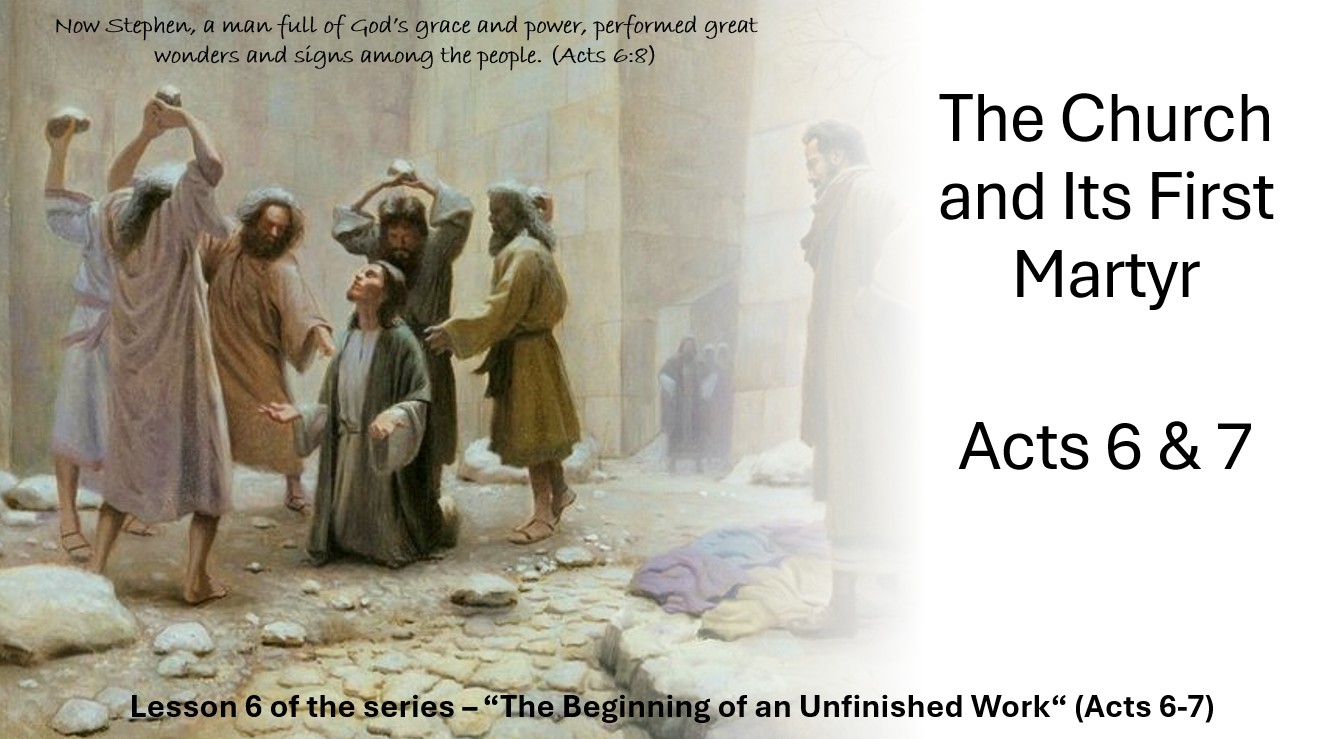
To Stephen’s point, the temple had become a “type or form” of idol worship to the religious leaders, and they simply could not acknowledge that Jesus was the fulfillment of the law and the temple. This did not sit well with the religious leaders and sets the stage for the Sanhedrin’s full condemnation of Stephen by ordering him to be taken out of the city and stoned to death. They had no right to do this but neither did they have the right to demand the crucifixion of Christ. This is how Luke closes out Acts 7; “While they were stoning him, Stephen prayed, “Lord Jesus, receive my spirit.” Then he fell on his knees and cried out, “Lord, do not hold this sin against them.” When he had said this, he fell asleep.” (Acts 7:59-60). This is a powerful reminder of how we should act towards others, even those who may be our enemies. You may never fully know the impact of your life on someone else (whether it is a believer or an unbeliever, an enemy or friend) and it’s in these moments of crisis where our faith and belief really show the Jesus we believe in, to those around us.

The Beginning of an Unfinished Work Part 3 – In the Name of Jesus (Acts 3)

In the Name of Jesus – Acts 3

Part 3 in the Series – “The Beginning of an Unfinished Work”

This chapter (Acts 3) begins with a miraculous event that initially involves 3 people (Peter, John and an unnamed crippled man), but the results will have far greater impact than any of them imagined. It has probably been somewhere around 3-6 months since the resurrection of Jesus and the healing of this crippled man. Even though the early Christians were meeting in their homes (Acts 2:46), they still had the right to access the temple which is where this miracle takes place.

Peter and John had made their way to the temple (as it was their right to do so) to pray. They encounter an unnamed crippled man who had positioned himself at the gate called “Beautiful” where he would beg for assistance in the form of money or food. Although the crippled man placed himself there for material assistance, God would use this as an opportunity to perform a miracle and bless him beyond his expectations. Upon seeing Peter and John who were about to enter the temple, he asked them for money. Instead of ignoring him like so many others, they paid attention to the crippled man.

Peter (by the power of the Holy Spirit) said; “Silver or gold I do not have, but what I do have I give you. In the name of Jesus Christ of Nazareth, walk.” There may have been other miracles performed by the Apostles prior to this, but this is the first miracle recorded in the Book of Acts. The unique power and ability to heal others was given by Jesus to the Apostles when he was with them during his earthly ministry and this authority continued throughout the Book of Acts and other New Testament writings:

Jesus called his twelve disciples to him and gave them authority to drive out impure spirits and to heal every disease and sickness. These are the names of the twelve apostles: first, Simon (who is called Peter) and his brother Andrew; James son of Zebedee, and his brother John; Philip and Bartholomew; Thomas and Matthew the tax collector; James son of Alphaeus, and Thaddaeus; Simon the Zealot and Judas Iscariot, who betrayed him. These twelve Jesus sent out with the following instructions: “Do not go among the Gentiles or enter any town of the Samaritans. Go rather to the lost sheep of Israel. As you go, proclaim this message: ‘The kingdom of heaven has come near.’ Heal the sick, raise the dead, cleanse those who have leprosy, drive out demons. Freely you have received; freely give.” (Matthew 10:1-8)

The people who witnessed the miracle were astonished and perhaps ready to hear the words of Peter, thus he begins to preach a compelling sermon about the powerful name of Jesus. Peter is speaking to fellow Israelites (probably less likely to be the “religious leaders” and more likely the common everyday Jew of their day) and pointed out that this miracle (the healing of the crippled man) should not come as a surprise for the prophets foretold that this would happen. What should have been obvious was that Peter and the other Apostles were a living illustration that the power of God rested on them. Peter intentionally directed all attention away from himself and John and will point them to Christ for it was because of Jesus they had the power to do these miracles. Peter will remind those whom he spoke to, of their knowledge and or participation (perhaps out of ignorance) in the crucifixion of Christ and will call them to repent, turn to God and trust in the name of Jesus to save them.

But what does it say? “The word is near you; it is in your mouth and in your heart,” that is, the message concerning faith that we proclaim: If you declare with your mouth, “Jesus is Lord,” and believe in your heart that God raised him from the dead, you will be saved. For it is with your heart that you believe and are justified, and it is with your mouth that you profess your faith and are saved. As Scripture says, “Anyone who believes in him will never be put to shame.” For there is no difference between Jew and Gentile—the same Lord is Lord of all and richly blesses all who call on him, for, “Everyone who calls on the name of the Lord will be saved” (Romans 10:8-13).

Many of those who were listening to Peter will heed his words and repent but some of the hearers of this message might have been less responsive to Peter’s words and thus the tide will begin to turn towards silencing their message by the religious leaders of their day. That will be the theme of the next chapter – Acts 4

The Beginning of an Unfinished Work Part 1 – Introducing the Church (Acts 1)

The Book of Acts seems to naturally pick up where Luke left off in his Gospel account in which he lays out in detail the life and ministry of our Lord Jesus Christ. Contained in Gospel record written by Luke is a clear “historical record” that begins with the virgin birth of Jesus and continues with His 3-year ministry on earth, providing detail as to His atoning death on the cross, and records the resurrection of Jesus which is the central doctrine of Christianity! (I Corinthians 15) The Book of Acts continues in that “historical” vein in which Luke begins with the commission by Jesus for the apostles (messenger/one who is sent out) to take the gospel to Jerusalem, Judea, Samaria, an uttermost part of the earth” and records for us in detail just how that is accomplished. Although Luke’s “inspired record” ends in Acts 28 with Paul’s arrival in Rome; contained in the passages between Acts 1 through Acts 28 are an endless amount of historical record that pieces together the early days of the Church. During this study, “The Beginning of an Unfinished Work”, we will explore his historical record as we weave or way through the book of Acts along with the Epistles/Letters written by other New Testament authors.

Introducing the Church – Acts 1

Part 1 in the Series – “The Beginning of an Unfinished Work”

After the resurrection and during the 40 days that Jesus walked the earth prior to his ascension into heaven, Jesus taught about the kingdom and instructs his disciples to return to Jerusalem and await his further instructions about the coming of the Holy Spirit. After the 40 days had been completed, Jesus ascends into heaven (Acts 1:9-11) and the disciples did as they were commanded and returned to Jerusalem.

While gathered together in Jerusalem, the 11 remaining apostles (Judas had hung himself and was now dead), several women including Mary the Mother of Jesus, Jesus’ brothers (these were biological siblings from Mary and Joseph after Jesus was born) who were James (who would become the leader of the Jerusalem church), Joses, Judas/Jude (author of Jude), and Simon, along with other disciples (120 in all) began to seek the Lord through prayer while awaiting the coming of the Holy Spirit. One of the tasks of the apostles was to find a replacement for Judas who betrayed Jesus and eventually killed himself. They were looking for an individual who was a witness to the earthly ministry of Jesus and an eyewitness to the resurrection. The two men that were nominated to fill Judas’ position was Joseph called Barsabbas and Matthias. After a time of prayer and seeking the Lord’s direction, they chose Matthias. Now that Matthias has been chosen, all was ready for the birth of the Church on the Day of Pentecost as described in Acts 2.

Three Years That Changed the World – The Need for Restoration and Renewal

Three Years That Changed the World – Lesson 23

The Need for Restoration and Renewal

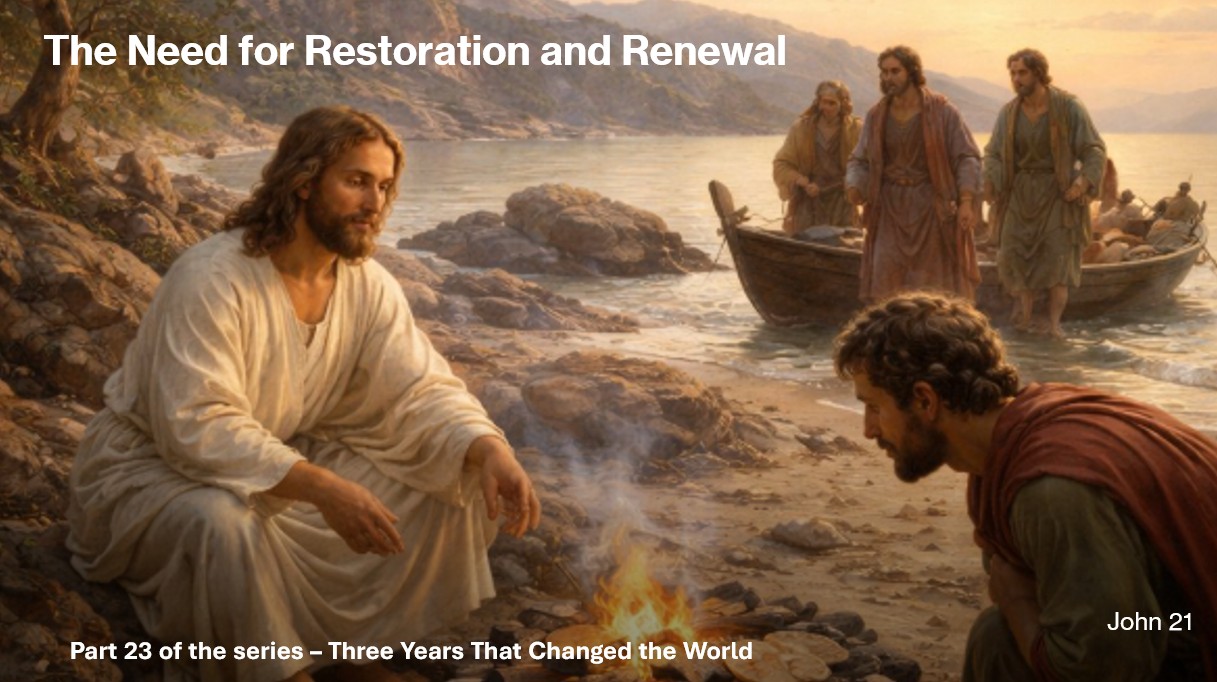
(Jesus in John 21)

The events that John records in this final account (John 21), occur after the disciples had left Jerusalem and made their way north to Galilee just as Jesus commanded them to do. Jesus had risen from the dead and revealed himself to his closest disciples’ multiple times as well as to many others.

We know from John’s account in chapter 21, that only 7 of the 11 disciples met with Jesus at the shore of the Sea of Galilee. They had been fishing all night but didn’t catch a thing. After coming back to shore, they met with Jesus, although they didn’t recognize him at first.

Since this was early in the morning it meant that the disciples had been fishing all night and a possible indication that this wasn’t a recreational adventure but a return to Peter’s former trade as a fisherman. Fishing at night was what serious fisherman would do as that is when they would expect to catch fish. The seven disciples were; Peter, James, John (Sons of Zebedee), probably Andrew and Philipp (the unnamed disciples) along with Thomas, and Nathanael.

Jesus had lit a fire and already started cooking breakfast (fish and bread) which he miraculously provided prior to the disciples landing on shore with their catch of fish. Not that long prior to this event, Peter had denied Jesus while he was sitting beside a fire (John 18:18,25) and now while sitting beside another fire he was about to be restored by the very one that he denied knowing.

There was a total of three questions that Jesus asked. Although we aren’t specifically told why Jesus asked these three questions in the manner that he did, the assumption is that it may have paralleled the three denials that Peter made as to whether he knew Jesus and or followed him. Perhaps the Lord may have been trying to emphasize to Peter the requirement for “full devotion” to the work he was called to do, and Peter may have been lacking in that area. Jesus’ interaction with Peter seemed to have several purposes which this account in John 21 reveals and the ultimate goal was to see Peter fully restored to his place of ministry. Peter was being challenged to abandon everything (this would include any worldly pursuits such as his own fishing business) and follow Jesus with his whole heart. Further, Jesus was probably instilling into Peter the expected commitment to the ministry he was called to; “Then He said to them, “Follow Me, and I will make you fishers of men.” (Matthew 4:19). The significance of this instruction by Jesus was tied not only to Peter’s restoration but to show his responsibility to care for (like a shepherd/Pastor) for his flock.

John closes his Gospel (being an eyewitness to the events recorded in his Gospel account) having the authority to declare that what he wrote about Jesus was 100% true.

“This is the disciple who testifies to these things and who wrote them down. We know that his testimony is true. Jesus did many other things as well. If every one of them were written down, I suppose that even the whole world would not have room for the books that would be written.” (John 21:24-25)

Neither John nor the other Gospel writers could not have captured everything Jesus said or did. What was written was done so under the inspiration of the Holy Spirit and contained everything we needed to know.

“Jesus performed many other signs in the presence of his disciples, which are not recorded in this book. But these are written that you may believe that Jesus is the Messiah, the Son of God, and that by believing you may have life in his name.”          (John 20:30-31)

Three Years That Changed the World Part 3 – Come Follow Me

Three Years That Changed The World

Lesson 3 – Come Follow Me – John 1:38-51

This lesson picks up just after John baptized Jesus. Although John the Baptist will continue to preach and point the way to Jesus, the emphasis and focus of the Gospel writers from this point forward will be on Jesus and not John the Baptist.

In fact, two of John the Baptist’s disciples (Andrew and John) will begin following Jesus shortly after Jesus is baptized. Although they will start following Jesus, there will be several encounters between John, Andrew, Peter and James before they fully commit to Jesus and leave their occupation as fisherman of fish and become fisherman of men! This lesson will reveal their hearts and motives behind their desire and decision to follow Jesus, the Son of God, the Savior and King. It is quite a compelling story that is just beginning to unfold.

Two others (Philip and Nathanael/Bartholomew) will recognize that Jesus is the Son of God, the King of Israel and leave everything to follow him. Their story is equally compelling as Nathanael (after meeting Jesus) will come to a full understanding of what the Psalmist wrote in Psalm 139:1-4, “You have searched me, Lord, and you know me. You know when I sit and when I rise; you perceive my thoughts from afar. You discern my going out and my lying down; you are familiar with all my ways. Before a word is on my tongue you, Lord, know it completely.”

The remaining 6 disciples will begin following Jesus later but all 12 will be called to go and preach the gospel (the Good News that Jesus is the Savior) and make disciples and compel others to also follow Jesus.

This 3-year journey in which Jesus will teach them who he is, why he has come and what they are to do is written in the 4 Gospel accounts. As we read through the Gospels (specifically the Gospel of John) we will witness multiple miracles, wonders and signs along with multitudes of people who are healed of all types of diseases and infirmities.

In the end, It is my prayer and hope that you will embrace what John writes toward the end of his Gospel account, “Jesus performed many other signs in the presence of his disciples, which are not recorded in this book. But these are written that you may believe that Jesus is the Messiah, the Son of God, and that by believing you may have life in his name.” (John 20:30-31)

Part 3 – Why The Church 3.1

Both the Gospels of Mattew and Luke provide a small glimpse (recorded in the first 3 chapters) into the birth and early years of the Life of Jesus and subsequently write about the miracles and teachings of Jesus until his death and resurrection takes place. The other 2 Gospel accounts of Mark (probably dictated by Peter) and John almost immediately begin with the public ministry of Jesus, and they also continue their writings up until the death and resurrection of Jesus.

I mention this to show that the majority of the Gospel accounts are written to lay the foundation that Jesus is the Son of God and by His authority the church was established. Jesus called twelve ordinary men from different backgrounds, occupations, and religious upbringings and began to teach them The Way. It was the Apostle John who wrote; “That which was from the beginning, which we have heard, which we have seen with our eyes, which we have looked at and our hands have touched—this we proclaim concerning the Word of life. The life appeared; we have seen it and testify to it, and we proclaim to you the eternal life, which was with the Father and has appeared to us. We proclaim to you what we have seen and heard, so that you also may have fellowship with us. And our fellowship is with the Father and with his Son, Jesus Christ.” (I John 1:1-3)

In a teaching moment; Jesus asked his disciples, Who do the people say the Son of Man is? He received several different replies; some say John the Baptist, others say Elijah, others say Jeremiah or one of the prophets. Then Jesus asked the disciples; “But what about you?” he asked. “Who do you say I am? Simon Peter answered, “You are the Messiah, the Son of the living God.” Jesus replied, “Blessed are you, Simon son of Jonah, for this was not revealed to you by flesh and blood, but by my Father in heaven. And I tell you that you are Peter, and on this rock I will build my church, and the gates of Hades will not overcome it.

This (Matthew 16:18) was the first mention of the word church and its basic meaning is the “called ones” which best defines what Jesus declared to Peter. The church in its purest sense is an organism and not an organization or a building. Over time, and even in the early days of the church as recorded in Acts, the need for structure and organization was necessary to help the church accomplish the mission or as some call it, “The Great Commission“. (Matthew 28:18-20). However, the church is and always will be “the called ones” for wherever two or three are gathered together in His name, He is in their midst. (Matthew 18:19-20).

This Lesson: “Why the Church – Part 1” is designed to show who the head of the church is which is Jesus Christ, how the church started and how that authority which was passed to the 12 Apostles to start the “Beginning of an Unfinished Work” made its splash on the world and continues until Jesus returns. (Acts 1:8)