
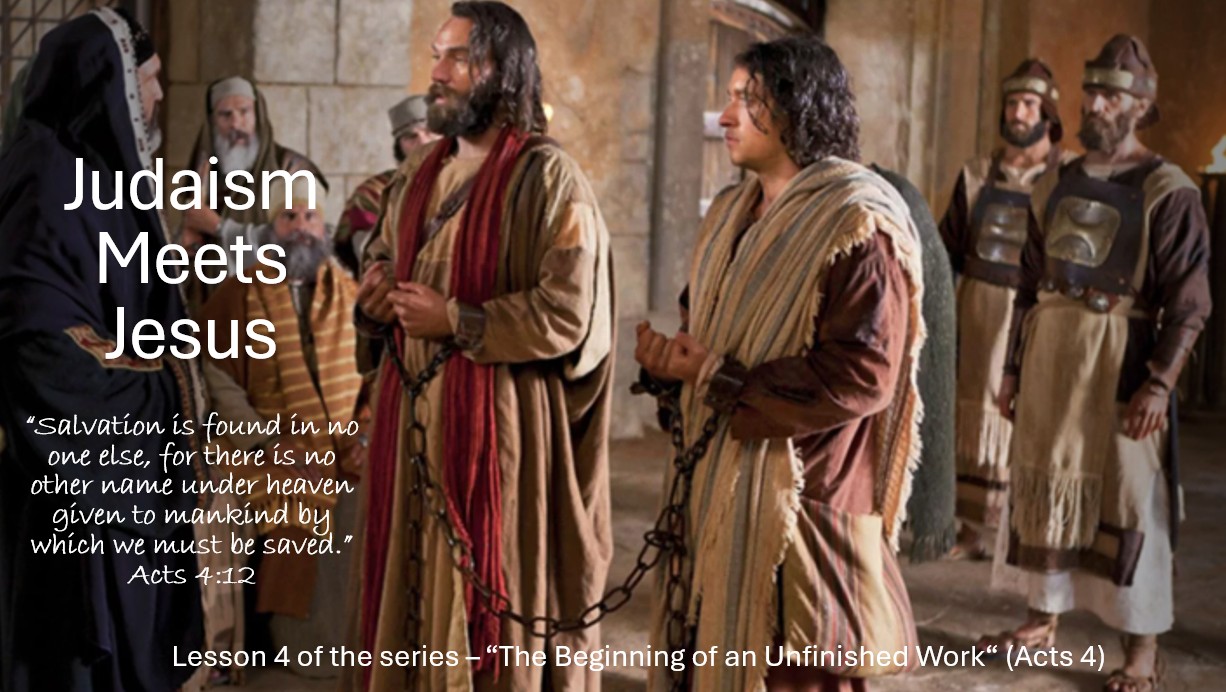
The Beginning of an Unfinished Work Part 4 – Judaism meets Jesus (Acts 4)

Judaism Meets Jesus – Acts 4

Part 4 in the Series – “The Beginning of an Unfinished Work”

With the birth and establishment of the Church (Acts 1-3) now on clear footing; the Jewish “religious leaders” begin to take notice. The Holy Spirit is working in the lives (through conviction) of both the religious leaders as well as the common person. Some will fully embrace Christ while others will continue to reject Him. Many of the religious leaders didn’t agree with the message that the Apostles were declaring but were paralyzed to do anything.

The cornerstone message that the apostles were teaching was the resurrection of Jesus from the dead. The apostles were witnesses to the resurrection of Jesus and for 40 days after that they listened to him teach about the kingdom, they ate with him and fellowshipped with him. They were compelled to proclaim the message that Jesus rose from the dead. This caused enough concern from the religious leaders that they decided to arrest Peter and John and convene a meeting of the Sanhedrin to determine if this healing of the crippled man (Acts 3) was valid and by what authority they could perform this miracle.

Peter set out to preach another sermon where he once again reminds the religious leaders that their authority to heal this man rested in the Name of Jesus Christ – the One they crucified! It was Jesus that granted them the authority and power to heal.

Jesus called his twelve disciples to him and gave them authority to drive out impure spirits and to heal every disease and sickness. These are the names of the twelve apostles: first, Simon (who is called Peter) and his brother Andrew; James son of Zebedee, and his brother John; Philip and Bartholomew; Thomas and Matthew the tax collector; James son of Alphaeus, and Thaddaeus; Simon the Zealot and Judas Iscariot, who betrayed him. These twelve Jesus sent out with the following instructions: “Do not go among the Gentiles or enter any town of the Samaritans. Go rather to the lost sheep of Israel. As you go, proclaim this message: ‘The kingdom of heaven has come near.’ Heal the sick, raise the dead, cleanse those who have leprosy, drive out demons. Freely you have received; freely give.” (Matthew 10:1-8)

The beggar (who was crippled) now stands before them in good health and complete wholeness of which the religious leaders could not dispute. Peter declares to them that the only way to cure their problem was to repent and believe in Jesus Christ. The religious leaders lacked faith, and they had no response for the crippled man walking in their midst because they didn’t believe in Jesus. They couldn’t prove Peter or James had done anything wrong and thus were unable to punish them for anything. The best solution they could produce was they told them to stop teaching about Jesus.

“It is particularly striking that neither on this nor on any subsequent occasion (as far as our information goes) did the Sanhedrin take any serious action to disprove the apostle’s central affirmation – the resurrection of Jesus. Had it been possible to refute them on this point, how readily would the Sanhedrin have seized the opportunity! Had they succeeded, how quickly and completely the new movement would have collapsed! (F.F. Bruce – The Book of Acts [Grand Rapids; Eerdmans, 1971 page 102)

Peter and John are subsequently released and they return to their brethren and continue to preach and teach about Jesus. In addition, we are told they continue to perform more miracles and wonders. This results in the church expanding to well over 10,000 people. They are unified in their love for one another, and they care for each other’s needs. They will face more persecution but that won’t stop them from declaring the truth that Jesus is the only way to God!

A new command I give you: Love one another. As I have loved you, you must love one another. By this everyone will know that you are my disciples, if you love one another.” (John 13:34-35)

Jesus answered, “I am the way and the truth and the life. No one comes to the Father except through me.” (John 14:6)
The Beginning of an Unfinished Work Part 3 – In the Name of Jesus (Acts 3)

In the Name of Jesus – Acts 3

Part 3 in the Series – “The Beginning of an Unfinished Work”

This chapter (Acts 3) begins with a miraculous event that initially involves 3 people (Peter, John and an unnamed crippled man), but the results will have far greater impact than any of them imagined. It has probably been somewhere around 3-6 months since the resurrection of Jesus and the healing of this crippled man. Even though the early Christians were meeting in their homes (Acts 2:46), they still had the right to access the temple which is where this miracle takes place.

Peter and John had made their way to the temple (as it was their right to do so) to pray. They encounter an unnamed crippled man who had positioned himself at the gate called “Beautiful” where he would beg for assistance in the form of money or food. Although the crippled man placed himself there for material assistance, God would use this as an opportunity to perform a miracle and bless him beyond his expectations. Upon seeing Peter and John who were about to enter the temple, he asked them for money. Instead of ignoring him like so many others, they paid attention to the crippled man.

Peter (by the power of the Holy Spirit) said; “Silver or gold I do not have, but what I do have I give you. In the name of Jesus Christ of Nazareth, walk.” There may have been other miracles performed by the Apostles prior to this, but this is the first miracle recorded in the Book of Acts. The unique power and ability to heal others was given by Jesus to the Apostles when he was with them during his earthly ministry and this authority continued throughout the Book of Acts and other New Testament writings:

Jesus called his twelve disciples to him and gave them authority to drive out impure spirits and to heal every disease and sickness. These are the names of the twelve apostles: first, Simon (who is called Peter) and his brother Andrew; James son of Zebedee, and his brother John; Philip and Bartholomew; Thomas and Matthew the tax collector; James son of Alphaeus, and Thaddaeus; Simon the Zealot and Judas Iscariot, who betrayed him. These twelve Jesus sent out with the following instructions: “Do not go among the Gentiles or enter any town of the Samaritans. Go rather to the lost sheep of Israel. As you go, proclaim this message: ‘The kingdom of heaven has come near.’ Heal the sick, raise the dead, cleanse those who have leprosy, drive out demons. Freely you have received; freely give.” (Matthew 10:1-8)

The people who witnessed the miracle were astonished and perhaps ready to hear the words of Peter, thus he begins to preach a compelling sermon about the powerful name of Jesus. Peter is speaking to fellow Israelites (probably less likely to be the “religious leaders” and more likely the common everyday Jew of their day) and pointed out that this miracle (the healing of the crippled man) should not come as a surprise for the prophets foretold that this would happen. What should have been obvious was that Peter and the other Apostles were a living illustration that the power of God rested on them. Peter intentionally directed all attention away from himself and John and will point them to Christ for it was because of Jesus they had the power to do these miracles. Peter will remind those whom he spoke to, of their knowledge and or participation (perhaps out of ignorance) in the crucifixion of Christ and will call them to repent, turn to God and trust in the name of Jesus to save them.

But what does it say? “The word is near you; it is in your mouth and in your heart,” that is, the message concerning faith that we proclaim: If you declare with your mouth, “Jesus is Lord,” and believe in your heart that God raised him from the dead, you will be saved. For it is with your heart that you believe and are justified, and it is with your mouth that you profess your faith and are saved. As Scripture says, “Anyone who believes in him will never be put to shame.” For there is no difference between Jew and Gentile—the same Lord is Lord of all and richly blesses all who call on him, for, “Everyone who calls on the name of the Lord will be saved” (Romans 10:8-13).

Many of those who were listening to Peter will heed his words and repent but some of the hearers of this message might have been less responsive to Peter’s words and thus the tide will begin to turn towards silencing their message by the religious leaders of their day. That will be the theme of the next chapter – Acts 4

The Beginning of an Unfinished Work Part 2 – The Church Begins

The Church Begins – Acts 2

Part 2 in the Series – “The Beginning of an Unfinished Work”

The “Day of Pentecost” (Acts 2:1) was the pre-ordained day that God chose for the Spirit to descend upon these believers to begin the work of the church. What transpired that day was something unique and like nothing ever seen or recorded before. Luke first described a sound that was like a “mighty rushing wind” and then a sight that he describes as “tongues of fire” that came to rest upon the believers in the upper room. It was clearly something supernatural and orchestrated by God Himself. Luke wasn’t an eyewitness but describes the event (through the inspiration of the Holy Spirit) as if he was there.

This “Coming of the Holy Spirit” in which He rested upon (filled) each person in the room that day, was marked by this external evidence of speaking in other tongues (other known languages – Acts 2:5-12) as the Spirit enabled them. This external supernatural occurrence was evidenced by an internal manifestation of the Holy Spirit that allowed these Galileans to speak and yet being understood by others in their own language.  

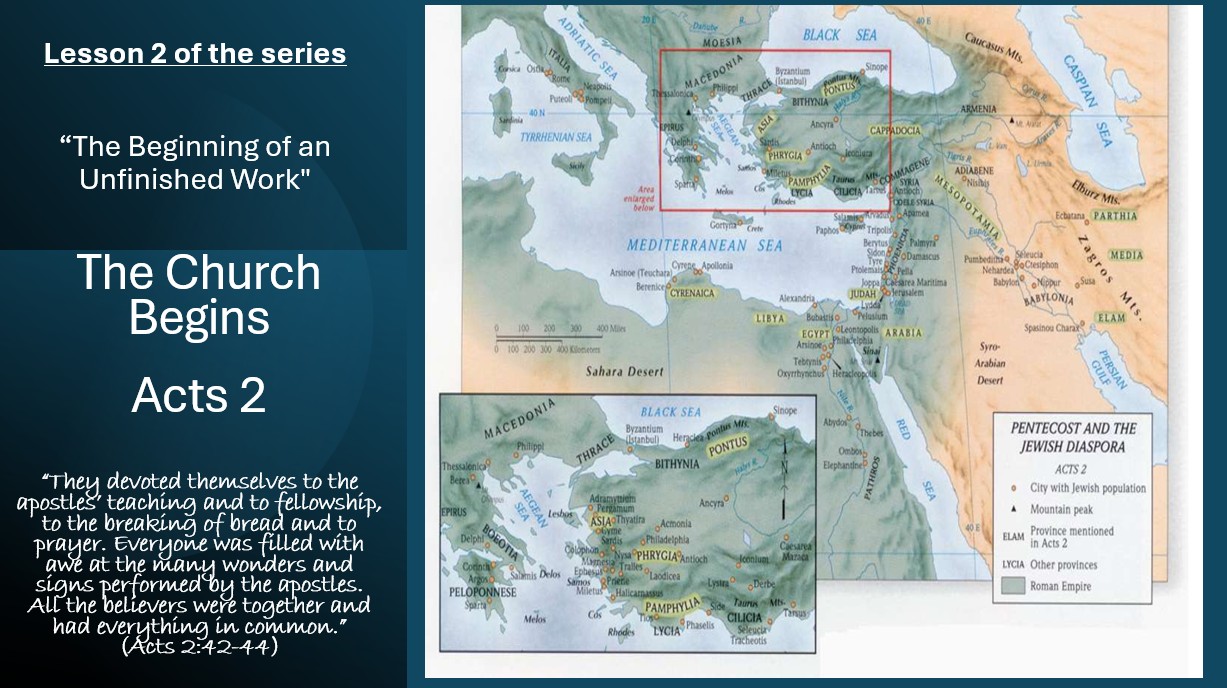
The timing of this event would fall sometime around May of 30 AD. or 33 AD. and the Roman Empire controlled Jerusalem and the entire region of what we refer to as the Holy Land, and most of the known Western regions along with the Near East. Also, by this time – large groups of Jews had migrated to other parts of the known world, much of it under the control of Rome. Some of them (labeled as God-fearing Jews) found themselves in Jerusalem to celebrate their required feasts where they would make sacrifice and bring offerings. These Jews must have been near the room where the disciples and others had gathered because Luke tells us that they heard the sound of the strong wind. At some point the apostles (and possibly other believers) began to speak. Perhaps they were preaching or prophesying (Acts 2:17-21). Luke doesn’t tell us exactly what they were speaking about but based on the balance of Acts 2, they were probably preaching about Jesus and the wonders of the kingdom of God. The Holy Spirit was clearly at work. Those believers who were speaking were Galileans and yet these others (God fearing Jews) from other regions of the Roman Empire could understand in their own tongue which was nothing short of a miracle.

At a later point, Peter begins to preach a message to not just these “God fearing Jewish” pilgrims but to a host of others who found themselves in ear shot of Peter. His message was simple, Jesus (the one they crucified) was both Lord and Christ and although they participated (directly or indirectly) in his crucifixion, Jesus rose from the dead. His resurrection from the dead was the greatest proof that Jesus is the Messiah and something that unbelieving mankind can only deny in ignorance. There is no proof to the contrary!

Peter’s closing argument was that they could continue to deny Jesus was Lord at their own peril, or they can recognize the overwhelming evidence that he presented, along with the irrefutable evidence that Jesus in fact rose from the dead. Those that heard Peter’s sermon were under conviction by the Holy Spirit and faced with the realization that they stood condemned before God! They now had a strong desire to be saved from that wrath and were willing to submit to God’s will. This resulted in over 3000 souls being added to the church and they continued meeting together in the temple courts of Jerusalem which was their right to do so. They moved about the community in which they lived, and other people (unbelievers) were able to witness their testimony of a changed or transformed life. This is the “Beginning of the Church” and it is only getting started!